Beauty claims decoded
What does 'hypoallergenic' actually mean?
The short answer
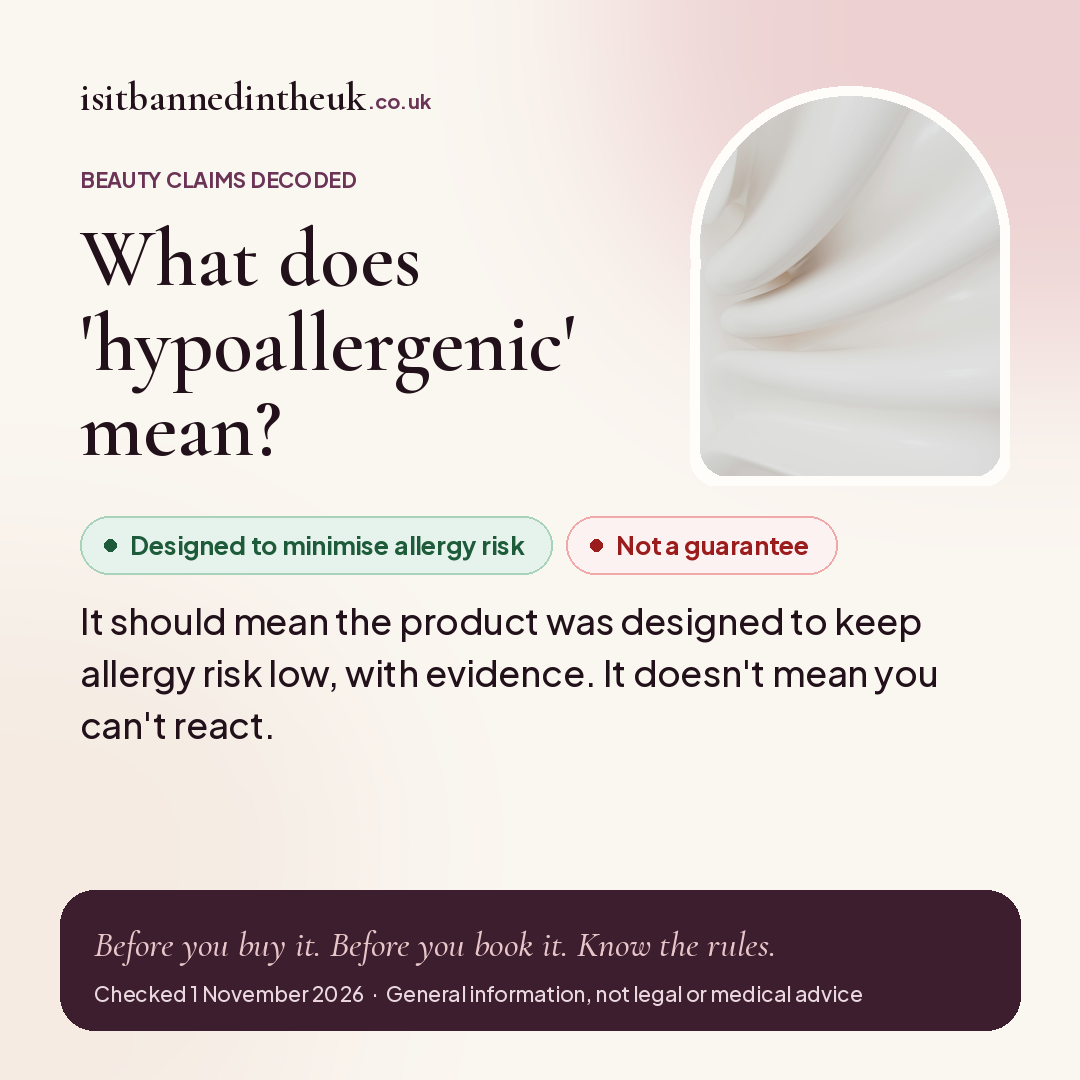
It should mean the product was designed to keep the risk of an allergic reaction as low as possible, with solid evidence to back that up. It doesn't mean you can't react. No product can promise that. Technical document, Annex IV
What the law requires (Great Britain)
- Labels and adverts must not imply that a product has characteristics or functions it doesn't have. UKCR Art 20(1)
- Every claim must meet six common criteria: legal compliance, truthfulness, evidential support, honesty, fairness and informed decision-making. UKCR Art 20(2) Reg 655/2013, Annex
- A claim is judged by how the average shopper would understand it: someone "reasonably well-informed and reasonably observant and circumspect". Annex, criterion 1(2)
Northern Ireland follows the EU version of these rules, which works in a similar way.
What the claim needs behind it
The cosmetics law we checked has no specific definition of "hypoallergenic". The claim still has to be truthful and backed by evidence, like any other claim. Reg 655/2013, Annex
European guidance for regulators (2017, not legally binding) says a hypoallergenic product should be designed to minimise its allergenic potential, with robust evidence to support that. It also says the claim mustn't suggest there's no risk of an allergic reaction at all. Technical document, Annex IV
So it isn't just another word for "gentle".
A question to ask the brand
"What evidence backs your hypoallergenic claim, and which common allergens have you left out?"
Frequently asked questions
Can hypoallergenic skincare still cause a reaction?
Yes. The European guidance says the claim must not suggest there's no risk of an allergic reaction at all. Technical document, Annex IV
Is hypoallergenic the same as 'for sensitive skin'?
Not necessarily. Each claim has to be judged on its own wording and the evidence behind it. Reg 655/2013, Annex
I have a known allergy. Is the word on the front enough?
No. Read the full ingredients list. The word on the front doesn't replace it.
Post this answer
A square image sized for Instagram. Download it and post it from your salon's account.
Download image