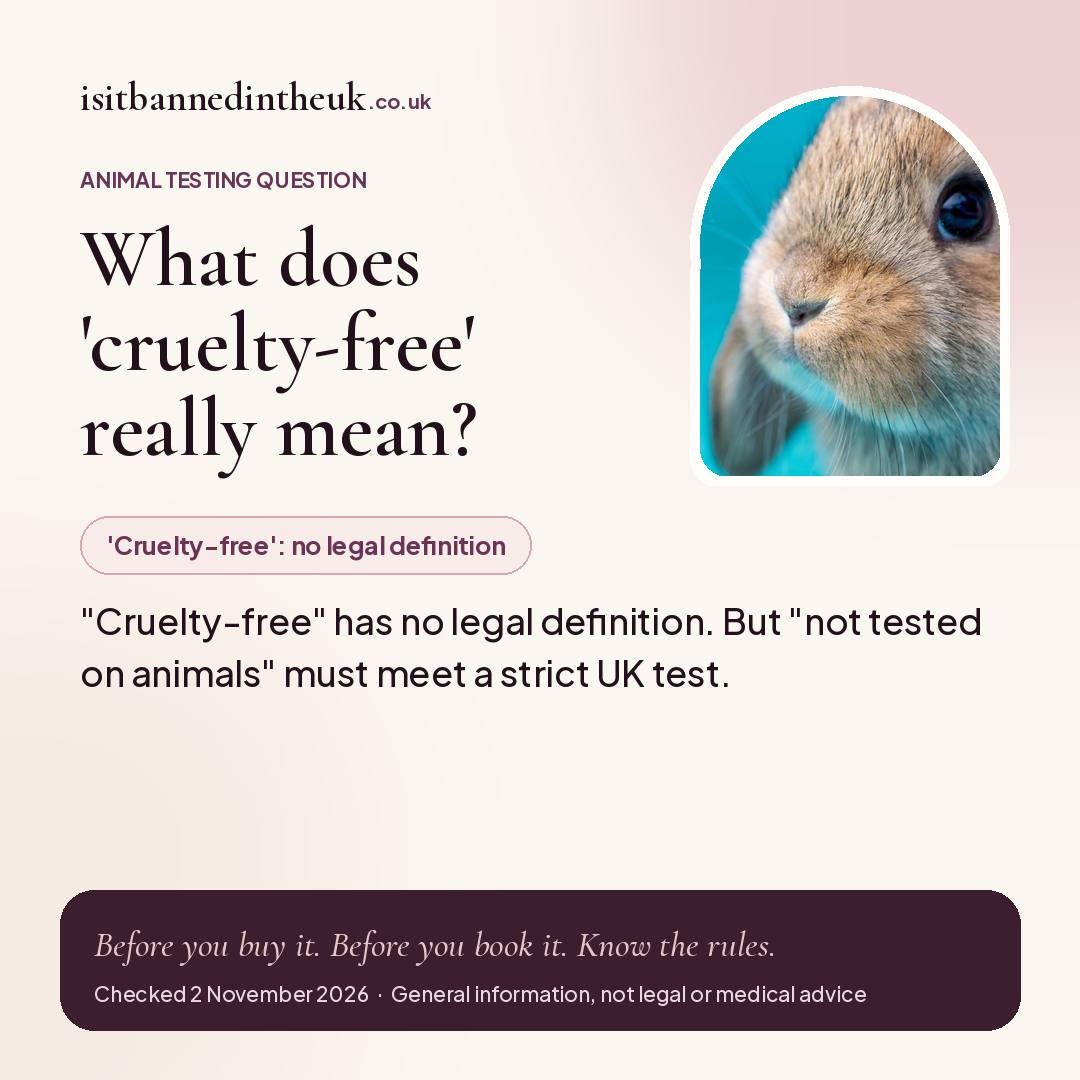
'Not tested on animals': strict legal test'Cruelty-free': no legal definition
There's no legal definition of “cruelty-free”. But if a label tells you a product wasn't tested on animals, UK law sets a strict test. Neither the brand nor its suppliers can have tested the product or any of its ingredients on animals, or had anyone else do it for them. They also can't have used ingredients that others tested on animals to develop new cosmetics. Logos such as the Leaping Bunny and the Vegan Society's sunflower come from private schemes, each with its own rules.
Common questions
What does 'not tested on animals' mean on a label?
UK cosmetics law
Strict legal test
A brand can only say this if neither it nor its suppliers have tested the finished product, an earlier version of it, or any of its ingredients on animals, or had anyone else do it for them. They also can't have used ingredients that others tested on animals to develop new cosmetics. The same rule applies in Northern Ireland.
Is 'cruelty-free' a legal term?
Rules on beauty claims
Must be backed by evidence
No. But a brand still has to be able to prove what its label tells you. If “cruelty-free” tells you the product wasn't tested on animals, it has to meet the strict test above. Like any beauty claim, it must also be true and backed by evidence.
What does the Leaping Bunny logo mean?
Cruelty Free International
Certification
It shows approval under Cruelty Free International's programme. Approved brands must set a fixed cut-off date for animal testing, check their suppliers, and have that checking independently audited. An approval can cover a whole company or just one brand, so look the brand up on Cruelty Free International's current approved list. Approval isn't a promise that no ingredient has ever been tested on animals.
Is cruelty-free the same as vegan?
The Vegan Society's Vegan Trademark
Certification
No. “Cruelty-free” is about animal testing. “Vegan” is about what's in the product. The Vegan Society's Vegan Trademark (the sunflower logo) covers both. Registered products must contain no animal products and involve no animal testing of any kind, including testing that another country's law requires, by the brand, anyone acting for it, or companies it controls. The scheme keeps traces of animal-derived substances very low but doesn't promise zero, and it isn't an allergy label.
What the law says
The responsible person may refer, on the product packaging or in any document, notice, label, ring or collar accompanying or referring to the cosmetic product, to the fact that no animal tests have been carried out only if the manufacturer and the manufacturer's suppliers have not carried out or commissioned any animal tests on the finished cosmetic product, or its prototype, or any of the ingredients contained in it, or used any ingredients that have been tested on animals by others for the purpose of developing new cosmetic products.
Whether a particular brand is cruelty-free or certified. Check the scheme's own search tool for the current list. A bunny drawing on its own doesn't mean any scheme has checked the product.